
by Teresa Currivan, LMFT
To understand neurodiversity, it is important to understand each neurodivergent (ND) trait that an individual student has. When I assess students, I look at the whole person in order to identify the various possible ND traits to understand any one of them – they do not operate in a vacuum. Each neurodivergent trait plays off of the other. The process is like a back-and-forth, and when I am finished, I can then help explain how all of the traits work together to make up the unique learning style of any student. In this way, we can understand the student in a holistic and precise way.
In this article, I will explain ADHD as only one piece of the possible puzzle of a neurodivergent student. Please do not use this article to diagnose or to make educational changes: it is important to understand the bigger picture before making any assumptions about a student’s learning needs.
Each ND trait should be fully understood to 1) understand how the other traits are impacted (how they co-occur) and therefore what the needs might be, and 2) to uncover which traits or challenges are being compensated for or hidden (sometimes referred to as masking). These are both topics for longer articles and training, but for now, understand that ADHD exists within the context of other learning needs, including strengths and challenges. (Also including where we, as the world’s typical education system, are falling short in meeting those needs.)
Let’s be precise about what ADHD is and what it is not.
What ADHD is Not
ADHD in the context of education and neurodiversity is not a mental health disorder in and of itself. It is a brain wiring that a student either has or does not have. It cannot be cured. It is an element of neurodiversity in that it is not the way that most of our population typically thinks and learns. A typical school setting is not set up for it (or any ND trait, just by definition alone). Typical parenting advice does not take it into consideration.
Any bi-products, or secondary mental health concerns that can come with ADHD (and that are often confused to be a part of ADHD) are due to how we understand it (or don’t.) How it plays out in a student’s education and social life due to our lack of understanding is often the cause of mental health fallout. The most common comments about students with ADHD (whether it has been identified or not) are that they are lazy, lack motivation, are trouble-makers, are defiant, etc. This belief and the disorders that ensue can eventually become reality. Therefore, sometimes having ADHD can lead to mental health disorders. I write about ADHD in order to prevent these disorders from happening. But to be clear, they are not a part of ADHD.
Besides these mental health bi-products, it is important to rule out a few things before assuming a student has ADHD. Two common look-alikes with similar symptoms are 1) having a dominant visual-spatial (VS) learning style, and 2) trauma. In order to differentiate between visual-spatial learning styles and ADHD, you will have to fully understand visual-spatial (VS) learning. I won’t go into it now, but making random connections and seeming to go off-topic in order to learn or get a point across is a big part of the VS style. But there are many, many other pieces of VS learning that need to be understood. (And to complicate matters, many students with true ADHD can have VS learning styles. Very often when I see ADHD described, it is VS learning, and not ADHD that is being described.) I won’t go too deeply into trauma here. There are many trauma-informed professionals who can speak to the temporary way that trauma can impact the ability to focus and to be organized in thought and in life. The biggest difference between ADHD and trauma is that trauma can be healed. This usually takes some time and a lot of compassion through work with a qualified mental health practitioner. I have seen people who appear to have ADHD as adults but did not as children. That is a sign that the symptoms are not ADHD. (The only way this could happen is from brain injury, in which case the brain wiring has changed.)
A few other ND traits that are confused with ADHD are sensory processing disorders (there are a few different varieties), high psychomotor drive, and having a kinesthetic learning style. There are many more, but these tend to be the top ones in my experience. It is important to understand that these other traits can accompany ADHD (and often do) and can be misdiagnosed as ADHD. They are often lumped together to describe ADHD. When sensory issues are addressed correctly, the “hyperactivity” often goes away. The term “hyperactivity” is usually attributed to a need to move (high psychomotor drive), or the need to move to think or to experience hands-on learning (kinesthetic learning style). If a student has both ADHD and a high psychomotor drive, they are usually moving in order to focus, especially when they are young. There are several other neurodivergent traits, too many to list in this article. I can not stress the importance of identifying these traits, not just to help a student who may or may not have ADHD, but in order to solve their school and social-emotional issues in general. Relationships, sensitivities, being able to level up and do deep dives in their work, their level of creativity, and so many more – these are all important needs to understand for each ND student. As a side, ND students (ADHD or otherwise) can be very easy to teach once their neurodivergent learning styles are accurately assessed.
I’ve created the graphic below to understand the basics of what ADHD is. The description is written below the graphic. Keep in mind that many students who have ADHD also have one or more of these other traits.
What ADHD is (Without any other neurodivergent traits.)
The ADHD Flow of Attention
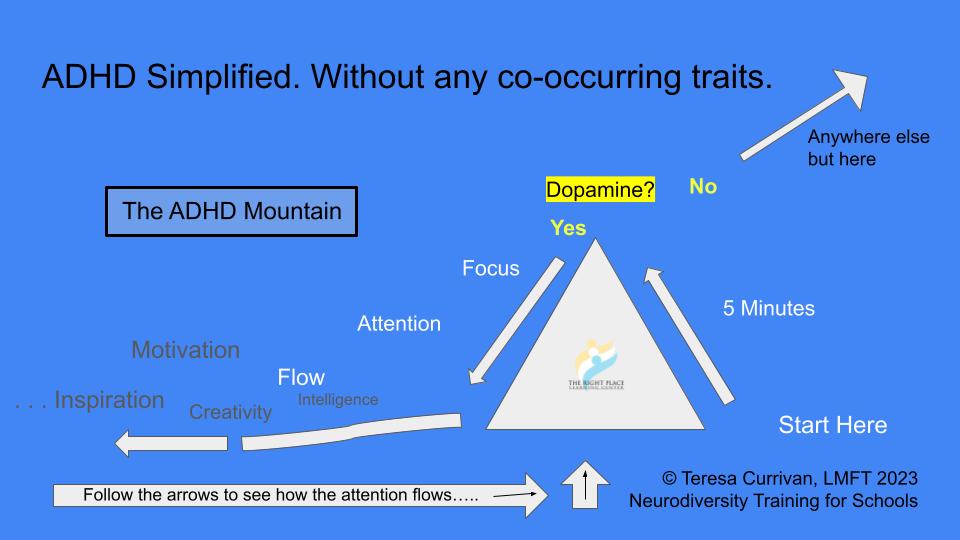
ADHD as we use the term today means that an individual can ONLY focus on a task for 5 minutes. If dopamine has kicked in by then, they can continue to focus. If not, they have no choice, but to find something else to focus on. (Fortnite, the kids out in the hall, their phone, the birds out the window…….)
This is not a cognitive choice. The brain has lost focus even though the person with ADHD may desire to stay engaged.
If the topic or learning style is a good fit, the dopamine kicks in and they can coast down the other side of the mountain. They are now in a state of flow and or hyper focus. They can lose sense of time, and all their best skills– social, intellectual and creative, are at their disposal.
That’s it. That’s ADHD.
ADHD When Combined With Neurodivergent Traits
All of the things that we see as part of ADHD in our child or our students: impulse control, inability to have a back-and-forth in a conversation, inability to sit still, etc., can all be explained when you combine ADHD with other neurodivergent traits. The most common behavior I see in school is when a student is not learning in his or her style, or at their level, there is a slim chance the appropriate amount of dopamine will kick in, and therefore there is a very slim chance they can focus in the classroom. Often, lecture-based classes do not work, not because of the ADHD alone, but because the student with ADHD may be a kinesthetic learner (hands-on), may need a socratic discussion (having a highly relational learning style), or for the topic to be more specific to an interest of theirs, either above grade level or below.
For example, if a student is a visual-spatial (VS) learner and has ADHD, it will be as though the visual-spatial aspects are on steroids. They cannot learn unless their VS learning style is addressed. While another student who is primarily VS will try their best to get in line with non-VS schoolwork, usually what they experience as mundane and repetitive work (although even they may become depressed by high school seemingly out of the blue), the student with ADHD and VS learning style will not be able to do anything outside of VS learning for more than 5 minutes. If they are very dedicated to doing well and succeeding, pleasing adults, perfectionistic (another ND trait,) some can make it work by going to the bottom of the mountain in the ADHD mountain, as described, above, but that can be exhausting, and they tend to be very tired by the end of each day, sometimes appearing to have meltdowns out of nowhere, and by high school, they sometimes give up altogether, again, seemingly out of nowhere.
This is why students with ADHD can present so differently from each other.
The upside is that if a student with ADHD and VS learning style is taught in a manner that suits his learning style, he may not appear to have ADHD, at least during the lesson and the completion of it. Remember the other side of the ADHD mountain is being in flow and hyper-focus. Perspective-taking, one’s relationship to time, ability to make friends, and many other outcomes or symptoms of ADHD are best explained through understanding the student’s other traits, and combining our understanding of that trait and how it combines with ADHD. For example, a student who loves numbers and order may enjoy being on time, which is not commonly considered an ADHD behavior. They may even hyper-focus on time.
Students whose education matches their learning style and who have ADHD, and who are given an understanding of ADHD and how their brain works, can be successful in school.
For some, medication can help. What I like about ADHD is that it shows us more clearly how a student thinks and learns: when a young student has ADHD, it is more difficult to fake it or to mask. Even if a student wants to be compliant and perform in a way that doesn’t suit them, they cannot. Many want to focus in class and do well, but they cannot make themselves. If they are gifted, it can get tricky. I’ve had a few students who, in middle school, can make things happen for a while, especially if they are motivated to please, and if there is a lot of pressure from their parents to be successful in school. For example, some will speed through math assignments before their 5 minutes is up (see diagram.) If they are gifted, and math is very easy for them, this can usually work until high school. (But please understand giftedness for each student in all of its depth. Giftedness is not just a leveling up, it is an entire make-up of neurodivergent traits that need to be understood.) In terms of medication, I prefer to understand a student’s learning style and ND traits before administering ADHD medication so that any adjustments to their education and parenting can be made before, based on my holistic way of understanding how they learn. Otherwise, we are using the medication to make them cope in a world that does not suit them. Their academics may improve for a time, but this is just a band-aid, and the deeper issues have not been resolved. It is best to fully understand a student’s ND traits before introducing ADHD medication.
Understanding each neurodivergent trait a student has offers a tremendous amount of clarity into how to support their education, their parenting needs, and can prevent negative mental health outcomes into their teen and adult years.
Remember that our current understanding of neurodiversity is in the beginning stages. This is a new and upcoming field. There is a lot of information about ADHD (and other ND traits) both among professionals and in the general public that still do not take into account the whole picture of other neurodivergent traits and their impact on each other.
Lastly, we need to address neurodivergent and gifted girls. I have dedicated another article to this topic. (Stay tuned.) If neurodiversity is a new field, our understanding of neurodiversity in girls is even newer. I don’t think women have ADHD as much as males and are currently being overdiagnosed with the label. We are just beginning to understand ND boys, and in my experience, ND girls are being lumped into the ADHD category for the same reason that ND traits are lumped together with ADHD in boys. I’ll leave that as a cliffhanger for now. Stay tuned. It’s an important topic.
I hope that this article provides clarity into ADHD and even into a holistic understanding of neurodiversity a bit. Even with my own writing, it’s difficult to talk about one without the other. With the right guidance, learning environment, parenting, and self-understanding, those with ADHD can lead a successful life of fulfillment and can contribute tremendous gifts to society, often even more than a neurotypical student.
©2024 Teresa Currivan
With updates in 2025

Teresa Currivan is an author, mother, licensed marriage and family therapist, school therapist, coach, and consultant for individuals and parents at Help My Child Thrive Coaching. She developed The Currivan Protocol™ Qualitative Assessment Tool to assess and address co-occurring issues in neurodivergent students. This has been popular in her private practice and she has adapted it for use in public and private schools. She is the author of the book, My Differently Tuned-In Child: The Right Place for Strength-Based Solutions. Teresa has been published on sites such as Mother.ly, Filter Free Parents, and is a blogger at GHF and Hoagies Gifted Education and is a contributing author to the GHF Press book, “Perspectives on Giftedness.” Teresa has connections to San Francisco Bay Area schools such as Fusion Academy, Big Minds Unschool, The Academy of Thought and Industry, and the San Francisco Unified School District (SFUSD.)
If you would like training for your school, an assessment or parent coaching for your child, you can contact Teresa at TeresaCurrivan@gmail.com
You may also be interested in my blog post, Are We Overdiagnosing Our Girls? or my other blog posts listed here: Teresa’s Blog, “Neurodivergent Musings…”

 HelpMyChildThrive.com
You must be logged in to post a comment.